
LISMORE CUP 2026
Where the River Meets the Racecourse

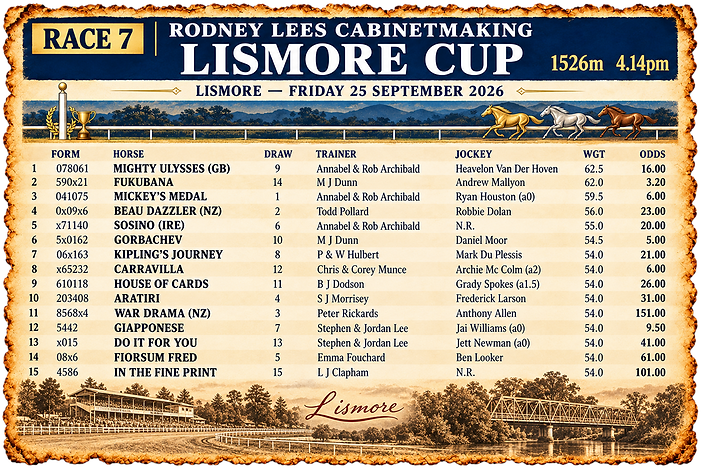
Selections reflect the field and information available on Cup Eve.
Scratching, riding and market changes may occur before race time.


Part 1. - Getting to Know the Place
Presenters - Sophie and Ben
Sophie had been looking out the window for the last twenty minutes.
Ben noticed.
“You’re very quiet.”
“I’m looking.”
“At what?”
“Everything.”
Ben smiled.
That was Sophie.
Some people arrived in a town wanting to know where the pub was.
Sophie wanted to know why the streets went where they did, what stood behind the old buildings and where the locals went when nobody was visiting.
Lismore was giving her plenty to look at.
A town built beside the river
Lismore sits in the Northern Rivers of New South Wales, where the Wilsons River curls through rich farmland, rolling country and subtropical green.
The river helped shape the town.
It brought transport, opportunity and fertile country—but it has also brought some of Lismore’s hardest days.
Flooding has been part of the city’s story for generations. The devastating floods of 2022 left scars that remain impossible to separate from modern Lismore.
But Sophie wasn’t interested only in what had been lost.
She noticed what had returned.
Businesses reopening, buildings being repaired, people coming back to familiar corners.
A city continuing to find its feet.
“You get the feeling this place has had to start again a few times,” she said.
Ben nodded.
“And keeps doing it.”
That seemed important.

Around the heart of Lismore
They wandered through the centre of town.
Lismore hadn’t been polished into something designed purely for visitors.
That was part of its appeal.
Old shopfronts stood beside newer businesses. Cafés, pubs and galleries lined streets carrying reminders of several different versions of the city.
Sophie stopped more than once with her camera.
Ben eventually learnt not to ask how long she would be.
At one corner, she turned around.
“You know what I like about it?”
“What?”
“It feels lived in.”
Ben looked along the street.
“That’s because people live here.”
Sophie stared at him.
“Thank you, David Attenborough.”
They kept walking.
Because beneath the humour was something they were both beginning to understand.
Lismore wasn’t pretending nothing difficult had happened.
It simply hadn’t allowed the difficult years to become its entire story.
And a few kilometres away, another part of that story was waiting.

A racecourse the town chose to keep
Racing has been part of life around Lismore for generations.
Today, the Lismore Turf Club races at its North Lismore course, where the annual Lismore Cup remains one of the region’s important sporting and social occasions.
Sophie and Ben arrived while the course was still being prepared.
There was no Cup Day crowd and no roar from the straight—just the quiet business of getting a racecourse ready.
A couple of trackmen were checking and tending the surface.
Sophie watched them for a moment.
“This is the part nobody sees.”
Ben looked across the empty course.
“Unless something goes wrong.”
“Exactly.”
She raised the camera.
The rails were in place.
The winning post stood waiting.
And somewhere beyond the quiet course, horses were being prepared for a race still days away.
On Friday, 25 September 2026, everything would change.
The Lismore Cup, run over 1590 metres, would bring the town back to the track.
And this time, Race Day Co would be there too.
The Cup is coming
Sophie rested her arms on the rail.
“So what happens now?”
“We wait for the field,” Ben said.
“And then?”
“We study it.”
“And then?”
“We pretend we knew the winner all along.”
Sophie laughed.
“That sounds more like racing.”
Behind them, the work continued.
Ahead of them, the course stretched towards the winning post.
Lismore had shown them its river, its streets and something of the spirit that kept the city moving forward.
The next time Sophie and Ben came through those gates, the place would look very different.
Friday, 25 September 2026.
Lismore Cup Day.
The town had done its part.
Now it was almost time for the horses.

“Carravilla in front. Fukubana trying to reach her…”
For a moment, the Lismore Cup appeared to hang between them.
Carravilla had made her move. Fukubana was gathering momentum down the outside, while Kipling’s Journey searched for room closer to the rail.
Then came the call.
“Carravilla! Carravilla beat Fukubana.”
Sophie looked across at Ben.
“Ten kilograms,” she said.
In the end, that was the story of the 2026 Rodney Lees Cabinetmaking Lismore Cup.
Carravilla carried 52 kilograms. Fukubana carried 62.
The margin between them was only 0.3 lengths.
Before the race, Matthew Dunn’s representative Holly Julius had spoken warmly about Fukubana. The gelding had endured his share of issues during earlier preparations, but this time he was relaxing, finishing his races properly and arriving at Lismore in excellent order.
He had previously raced well at the track, and there was little doubt he possessed the class to win. The questions were the weight and the wide barrier.
Stablemate Gorbachev was expected to roll forward, and that was exactly what happened.
But another interview would prove even more prophetic.
Munce stable representative Don Barron admitted Carravilla was stepping into stronger company, but there were compelling reasons to take the chance.
She was racing well. She would carry almost no weight. Archie McColm was riding with confidence.
“We’ve got to have a crack,” Don said.
The plan was to move forward from the awkward gate, settle among the first three or four and give Archie the opportunity to bring her towards the middle of the track when the race became serious.
It was not merely a hopeful plan. It became an exact description of the winning ride.
When the gates opened, Gorbachev found the lead, with Do It For You and Aratiri prominent. Carravilla crossed from her outside barrier and Archie allowed her to settle comfortably in fourth position, never far from the speed.
Fukubana was behind her and faced the more difficult passage.
Approaching the 600 metres, Carravilla remained within a length of the leaders. Archie waited until the field began turning for home, then eased the mare three-wide into clear running.
He did not become trapped towards the inside. He did not ask her to move too early.
Archie McColm found the right position—and then chose the right moment.
Do It For You challenged Gorbachev at the top of the straight, but Carravilla was already building alongside them. She reached the front near the final furlong and immediately gave her pursuers something to catch.
Fukubana finally found open ground and began charging down the outside. Kipling’s Journey continued to improve nearer the rail, while Do It For You fought bravely after racing close to the pace.
Fukubana kept coming.
Carravilla kept answering.
The post arrived just in time for the mare, with Kipling’s Journey taking third and Do It For You holding fourth.
Mickey’s Medal had his opportunity compromised in the opening strides when he missed the start and settled near the rear. His young rider attempted to improve around the turn and brought him wide in search of clear running, but by then the leading horses had established a decisive advantage. Mickey’s Medal continued to try, and his finishing position did not fully reflect the task he faced after losing his position at the start.
The best-weighted runner had defeated the topweight—but Fukubana lost nothing in defeat.
He carried ten kilograms more than the winner, came from behind her and still reduced the margin to less than a third of a length. It was the performance of a very good horse and one that will be remembered when the Big Dance markets and weights are considered.
Carravilla’s victory was no surprise to the punters.
Support continued to arrive as race time approached, firming her into $4.40 behind the $3.50 favourite Fukubana. Those who followed the money had correctly recognised the opportunity created by her form, light weight and young rider.
After the race, Don Barron was waiting with a smile.
The broadcast team had admired how beautifully Carravilla had been presented in the mounting yard. When it was jokingly suggested that former champion jockey Chris Munce might not have personally put a brush over her, Don replied that Chris still did—he could “just reach.”
It was a lovely moment after a wonderfully planned victory.
Don had said they needed to give the race a crack. Chris and Corey Munce had produced the mare in magnificent condition, and Archie had rewarded their confidence with a composed and decisive ride.
Carravilla had not simply won the Lismore Cup. She had earned her place on the Road to Randwick.
Sophie folded the form guide and smiled.
“We had the race nearly right.”
Ben nodded. Fukubana had been their selection. Carravilla had been clearly identified as the lightweight danger, while Gorbachev had given the race the expected shape.
They had found the principal players and anticipated how the contest might unfold.
They had simply chosen the horse carrying ten kilograms more.
Sometimes class wins the argument.
On this occasion, weight, placement and one perfectly timed ride had the final word.
Carravilla was the 2026 Lismore Cup winner—and Archie McColm had ridden a race worthy of the occasion.
The last of the afternoon light was slipping across the Wilsons River as Sophie and Ben walked beside the water.
For once, Sophie’s camera remained in her bag. She had something else on her mind.
“Fifteen runners,” she said. “And I can already hear you telling me the favourite has drawn too wide.”
Ben smiled. “I was going to wait until dinner.”
“You’ve been studying the field all afternoon.”
“I’ve been thinking.”
“That usually means you haven’t decided.”
He couldn’t argue with that.

By the time they found a table overlooking the river, the form guides were spread between two dinner plates and a bottle of wine.
Sophie studied the top of the field. “Mighty Ulysses?”
“That depends on whether he comes here,” Ben replied. “He’s also nominated for Dubbo on Sunday, and the connections have a decision to make.”
His Coffs Harbour Cup victory had earned their respect, but carrying 62.5 kilograms from barrier nine would be a serious assignment.
Mighty Ulysses had already proved his quality—but the weight and his Dubbo nomination left one important question unanswered.
Sophie moved down to Fukubana. The favourite had won impressively at Eagle Farm and had previously run well in a Country Championships qualifier at Lismore.
“He knows the place,” she said.
“He does. But barrier fourteen and 62 kilos give Andrew Mallyon plenty to think about.”
“So you’re finding reasons to oppose the favourite?”
“I’m finding reasons not to declare him.”
Sophie poured the wine. “That sounds much safer.”
They both liked Gorbachev. He had shown speed and fought on well at Eagle Farm, and the drop to 54.5 kilograms made him one of the most interesting runners in the field. Barrier ten was another challenge, although his ability to race forward could help Daniel Moor find a position before the first turn.
Carravilla brought a different profile. She was on the quick back-up after another honest performance at the Gold Coast, carried 54 kilograms before Archie McColm’s claim and looked capable of putting herself into the race.
Fukubana held the market, while Gorbachev and Carravilla carried the lighter weights and presented the strongest challenge.
Mickey’s Medal had drawn barrier one and was dropping in grade, while Giapponese appealed as the horse likely to settle back and finish strongly. Ben also placed a small mark beside House of Cards, a Tuncurry winner two starts earlier who could add some value to the exotics.
Sophie looked across the table. “It’s always good to read what the established form analysts see.”
“Absolutely,” Ben said. “You don’t have to agree with every opinion, but you’d be silly not to listen.”

Their dinner was getting cold, but the race was gradually becoming clearer.
The early speed appeared likely to come from Gorbachev, Carravilla and Aratiri, with several others also capable of pressing forward. In a field of fifteen, those first few hundred metres could decide who received the right run and who spent the afternoon searching for one.
Finding the best horse was only half the job. Finding the horse most likely to receive the right run mattered just as much.
Sophie returned to the favourite. “Fukubana has the form, the local experience and Andrew Mallyon.”
Ben nodded. “And Gorbachev gets twenty-six and a half kilos from Mighty Ulysses.”
“That sounds rather persuasive.”
“It does when you say it slowly.”
By the time the plates had been cleared, they had narrowed the Lismore Cup down to four leading chances.
Fukubana was the horse to beat, with Gorbachev, Carravilla and Giapponese the principal dangers. House of Cards was their runner at odds.
The Race Day Co selections
First: No. 2 Fukubana
Main danger: No. 6 Gorbachev
Next best: No. 8 Carravilla
Include: No. 12 Giapponese
One at odds: No. 9 House of Cards
Sophie folded the form guide.
“So, lobsters or fish and chips?”
Ben lifted his glass and looked towards the river.
“Ask me at 4.15 tomorrow.”
Selections reflect the field and information available on Cup Eve. Scratching, riding and market changes may occur before race time.
Part 3 — The Cup Review
When Ten Kilograms Told the Story
Part 2
A racecourse the town chose to keep